
In today’s fast-evolving business landscape, organizations face constant pressure to innovate, adapt, and scale. Customer expectations are rising, competition is intensifying, and technological advancement continues at an unprecedented pace. In such an environment, relying solely on traditional business models is no longer enough to remain competitive.
This is where digital transformation becomes essential.
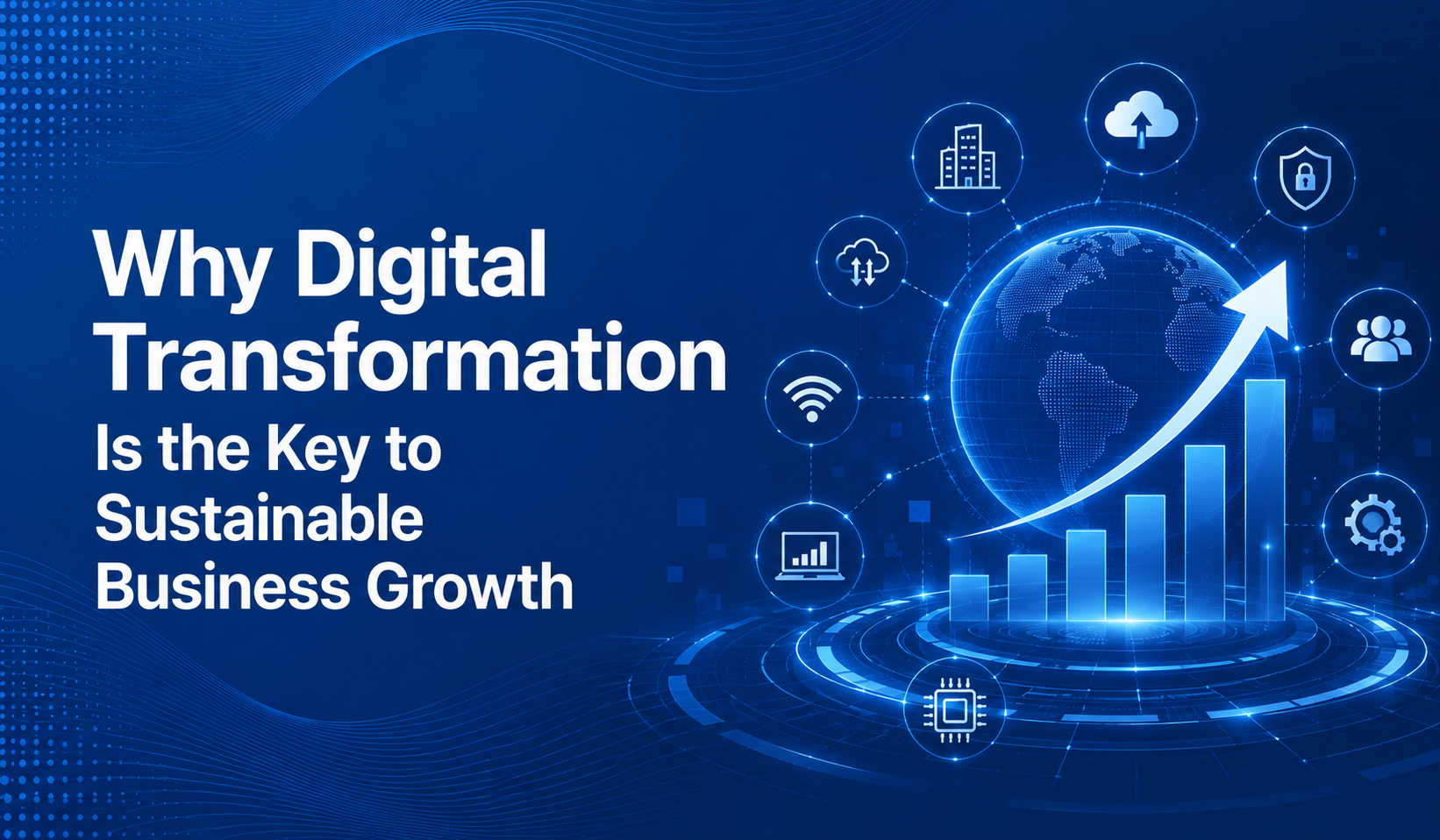
Digital transformation is not merely about implementing new software or upgrading IT systems. It represents a strategic shift in how businesses operate, deliver value, and prepare for future opportunities. Organizations that embrace digital transformation effectively are better positioned to improve efficiency, enhance customer experiences, and achieve sustainable long-term growth.
Understanding Digital Transformation
Digital transformation refers to the integration of digital technologies into core business functions to improve agility, efficiency, and innovation.
It reshapes how organizations:
- Operate internally
- Serve customers
- Manage and analyze data
- Optimize workflows
- Make strategic decisions
- Scale operations
Successful transformation requires more than technology adoption. It demands alignment between technology, business strategy, and people.
Organizations that foster a culture of innovation and continuous improvement gain the greatest value from digital transformation initiatives.
Why Businesses Can No Longer Ignore Digital Transformation
The business environment is changing faster than ever before. Several key factors are accelerating the need for transformation.
Rising Customer Expectations
Modern customers expect fast, seamless, and personalized experiences across every touchpoint.
Intensifying Competition
Digital-first companies can scale rapidly, innovate faster, and disrupt traditional industries.
Increasing Operational Complexity
As businesses grow, manual processes become costly, inefficient, and difficult to manage.
The Explosion of Business Data
Organizations generate vast amounts of data daily. Without proper analytics, valuable insights remain unused.
Businesses that delay modernization often face reduced agility, slower decision-making, and limited scalability.
Key Benefits of Digital Transformation
Organizations investing in digital transformation gain measurable competitive advantages.
Improved Operational Efficiency
Automation reduces repetitive manual work, improves productivity, and lowers operational overhead.
Better Decision-Making
Real-time analytics enables leaders to make faster and more informed strategic decisions.
Enhanced Customer Experience
Digital systems improve responsiveness, personalization, and service quality.
Greater Scalability
Modern infrastructure supports growth without creating major operational bottlenecks.
Stronger Competitive Advantage
Digitally mature businesses adapt more quickly to changing market demands.
These advantages create a strong foundation for long-term business success.
The Role of Software Development in Transformation
Custom software development plays a critical role in digital transformation.
Every business has unique processes, goals, and operational challenges. While off-the-shelf software may solve generic problems, custom-built solutions create greater long-term strategic value.
Custom software helps businesses:
- Automate workflows
- Improve operational visibility
- Integrate systems
- Strengthen customer engagement
- Improve security
- Scale efficiently
From enterprise platforms and web applications to API integrations and cloud-native architectures, software development forms the digital backbone of modern business transformation.
Data-Driven Organizations Perform Better
Data has become one of the most valuable assets in modern business.
Organizations generate data from:
- Customer interactions
- Sales transactions
- Operational workflows
- Marketing campaigns
- Performance metrics
When analyzed effectively, this data enables strategic decision-making and business growth.
Data analytics helps organizations:
- Identify growth opportunities
- Understand customer behavior
- Predict market trends
- Improve forecasting
- Reduce business risks
- Optimize operations
Data-driven organizations consistently outperform competitors by making smarter, evidence-based decisions.
Cloud Infrastructure Enables Scalability
Scalable and reliable infrastructure is essential for digital transformation.
Traditional infrastructure often limits flexibility, speed, and growth potential.
Cloud computing addresses these challenges by offering:
- On-demand scalability
- Greater accessibility
- Lower infrastructure costs
- Better collaboration
- High availability
- Strong disaster recovery capabilities
Cloud-native environments enable businesses to innovate faster while maintaining resilience and operational continuity.
This makes cloud adoption a critical pillar of modern transformation strategies.
Automation Accelerates Business Growth
Manual processes slow productivity and consume valuable resources.
Tasks such as:
- Data entry
- Reporting
- Customer onboarding
- Workflow approvals
- Inventory management
can create unnecessary delays when handled manually.
Automation improves operational speed by eliminating repetitive tasks.
Key benefits include:
- Reduced operational costs
- Faster execution
- Lower error rates
- Higher productivity
- Improved consistency
Organizations that automate strategically gain significant scalability and efficiency advantages.
Innovation as a Core Business Mindset
Technology alone does not guarantee successful transformation.
True transformation requires a mindset centered around:
- Continuous learning
- Innovation
- Adaptability
- Collaboration
- Strategic thinking
Businesses that embrace innovation are better equipped to navigate disruptions and capture future opportunities.
Digital transformation succeeds when both technology and people evolve together.
How BAIRACORP Private Limited Drives Digital Transformation
BAIRACORP Private Limited helps organizations accelerate growth through technology-driven solutions and strategic consulting.
Its expertise includes:
- Software Development
- Digital Transformation
- Business Consulting
- Data Analytics
- IT Infrastructure
- Cloud Solutions
- Strategic Planning
- Project Management
- Innovation Consulting
By combining advanced technology with business strategy, BAIRACORP helps organizations build scalable, secure, and future-ready digital ecosystems.
Its delivery framework includes:
Discovery & Strategy
Understanding business challenges and identifying growth opportunities.
Solution Design
Creating scalable and efficient technology architectures.
Development & Integration
Building robust, high-performance digital solutions.
Testing & Optimization
Ensuring performance, security, and reliability.
Deployment & Support
Enabling long-term operational success and continuous improvement.
The Future Belongs to Digitally Ready Businesses
Emerging technologies such as:
- Artificial Intelligence
- Machine Learning
- Cloud Computing
- Advanced Analytics
- Intelligent Automation
- Scalable SaaS Platforms
are transforming industries at extraordinary speed.
Businesses investing in digital transformation today will be better positioned to lead tomorrow.
The future belongs to organizations that can adapt rapidly, innovate continuously, and leverage technology strategically.
Conclusion
Digital transformation is no longer optional it is a strategic necessity.
Organizations that modernize operations, embrace automation, leverage data, and build scalable digital foundations create sustainable paths to long-term growth.
By combining innovation, strategic planning, and technical excellence, businesses can turn challenges into opportunities and build lasting competitive advantages.
With deep expertise in software development, digital transformation, and business consulting, BAIRACORP Private Limited continues to empower organizations to achieve digital excellence and sustainable business success.
Ready to Transform Your Business?
Explore how digital transformation can unlock growth for your organization.
Empowering Businesses Through Innovation, Technology, and Sustainable Growth.