
In today’s highly competitive business landscape, growth is no longer determined solely by sales performance or market reach. Sustainable growth depends heavily on how efficiently an organization operates behind the scenes. Even businesses with strong demand and exceptional products can struggle when internal processes are slow, inconsistent, or resource-intensive.
This is where Business Process Optimization (BPO) becomes a critical strategic advantage.
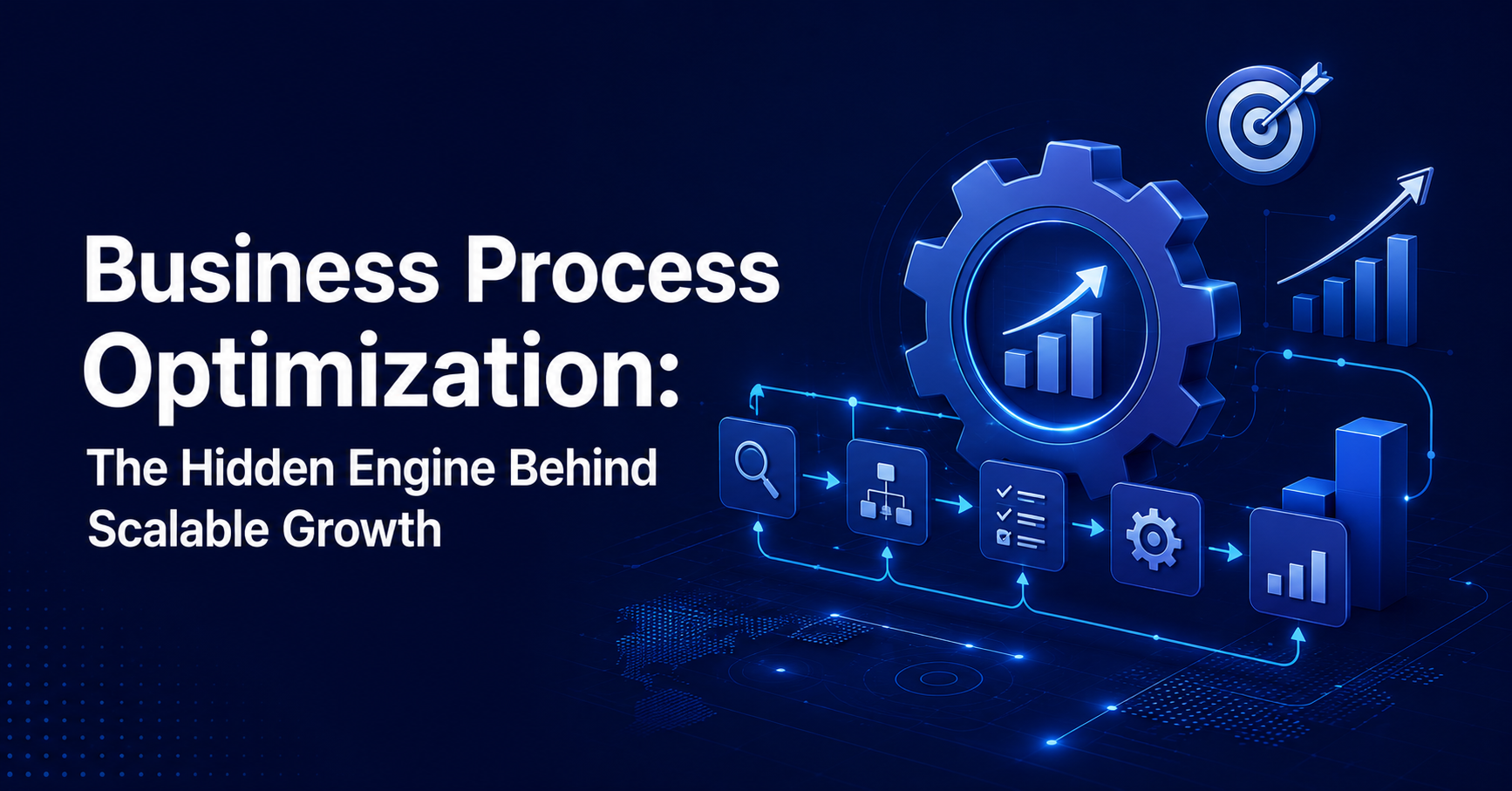
Business Process Optimization focuses on analyzing, refining, and streamlining workflows to eliminate inefficiencies, reduce operational costs, and maximize productivity. It enables organizations to operate smarter, respond faster, and scale effectively in increasingly complex markets.
For modern enterprises, optimization is no longer just about saving time it is about building a strong operational foundation for innovation and long-term success.
What Is Business Process Optimization?
Business Process Optimization is the systematic practice of evaluating existing workflows and improving them to achieve better performance, efficiency, and business outcomes.
Every organization relies on essential business processes such as:
- Customer onboarding
- Sales workflows
- Inventory management
- Internal approvals
- Reporting systems
- Service delivery
- Financial operations
Over time, these processes often become inefficient due to manual tasks, outdated systems, duplicated work, or communication bottlenecks.
Optimization helps identify these inefficiencies and improves workflows through strategic planning, automation, and modern technology.
Why Inefficient Processes Limit Growth
As businesses expand, operational complexity increases. Without optimized workflows, organizations commonly face several challenges:
Delayed Operations
Critical tasks take longer than necessary due to process bottlenecks.
Higher Costs
Operational inefficiencies increase labor expenses and overall costs.
Human Errors
Manual processes often lead to mistakes and inconsistencies.
Poor Customer Experience
Slow internal workflows negatively impact service quality and response time.
Limited Scalability
Growth becomes difficult without efficient and repeatable systems.
These challenges reduce productivity and create barriers to sustainable expansion.
Key Benefits of Process Optimization
Organizations that optimize their operations gain significant competitive advantages.
Increased Efficiency
Teams spend less time on repetitive or low-value tasks.
Faster Decision-Making
Improved workflows accelerate approvals and execution.
Better Resource Utilization
Employees, tools, and systems are used more effectively.
Improved Accuracy
Reduced manual intervention lowers error rates.
Enhanced Customer Satisfaction
Faster and smoother service improves customer experience.
Stronger Scalability
Optimized processes support sustainable and scalable growth.
Even small improvements in workflow efficiency can create substantial long-term business impact.
Identifying Process Bottlenecks
Optimization begins with visibility.
Businesses must first understand where inefficiencies exist within their operations.
Common bottlenecks include:
- Repetitive manual data entry
- Delays in approval workflows
- Poor interdepartmental communication
- Redundant operational tasks
- Outdated legacy systems
- Disconnected software tools
Identifying bottlenecks allows organizations to prioritize improvement efforts where they deliver maximum impact.
Tools such as workflow mapping, data analysis, and performance measurement help uncover hidden operational pain points.
The Role of Automation in Optimization
Automation has become one of the most powerful drivers of process optimization.
Tasks that once required significant manual effort can now be automated using modern software solutions.
Examples include:
- Invoice generation
- Lead assignment
- Customer notifications
- Report creation
- Ticket routing
- Inventory updates
Automation helps businesses:
- Save time
- Reduce errors
- Improve consistency
- Increase productivity
- Scale efficiently
By automating repetitive tasks, teams can focus on strategic, creative, and high-value activities.
Technology as an Optimization Enabler
Technology plays a central role in modern business process optimization.
Digital solutions improve workflows through:
- ERP systems
- CRM platforms
- Analytics dashboards
- Workflow automation tools
- Cloud collaboration platforms
- Custom software solutions
The right technology ecosystem enhances visibility, coordination, and operational performance.
Businesses that align technology with process strategy consistently achieve better results.
Data-Driven Process Improvement
Optimization should never rely on assumptions.
Data enables businesses to measure process performance accurately and make informed decisions.
Key metrics include:
- Task completion time
- Cost per process
- Error frequency
- Customer response time
- Productivity rates
- Resource utilization
These insights help organizations identify opportunities for continuous improvement.
Data-driven optimization ensures process enhancement becomes an ongoing strategy rather than a one-time initiative.
Continuous Improvement Drives Long-Term Success
Business optimization is not a one-time project it is a continuous journey.
As businesses evolve, customer expectations, market dynamics, and technologies also change.
Organizations need a culture of continuous improvement, including:
- Regular process reviews
- Performance monitoring
- Technology upgrades
- Team feedback
- Workflow refinement
Businesses that continuously improve remain agile, competitive, and future-ready.
Operational excellence becomes a sustainable strategic advantage.
How BAIRACORP Helps Businesses Optimize Operations
BAIRACORP Private Limited helps businesses improve efficiency through intelligent technology solutions and strategic consulting.
Core expertise includes:
- Business Consulting
- Process Optimization
- Software Development
- Workflow Automation
- Data Analytics
- Strategic Planning
- IT Infrastructure
BAIRACORP works closely with organizations to identify inefficiencies, redesign workflows, and implement scalable digital solutions that improve operational performance.
The company’s approach focuses on building streamlined systems that enhance productivity, scalability, and sustainable growth.
Looking Ahead
As markets become increasingly competitive, operational efficiency will play a defining role in business success.
Organizations that optimize faster will adapt faster.
Process optimization will continue to drive:
- Business agility
- Cost efficiency
- Innovation
- Customer satisfaction
- Scalable growth
The future belongs to businesses that operate intelligently.
Conclusion
Business growth is not driven by strategy alone it depends heavily on execution.
Efficient processes enable organizations to operate faster, reduce costs, improve quality, and scale sustainably.
Business Process Optimization transforms operational challenges into growth opportunities.
With expertise in strategy, technology, and workflow optimization, BAIRACORP continues to help businesses build efficient, scalable, and future-ready operations.
Ready to Optimize Your Business Operations?
Visit: Bairacorp.in
Empowering Businesses Through Efficiency, Innovation, and Smart Process Optimization.