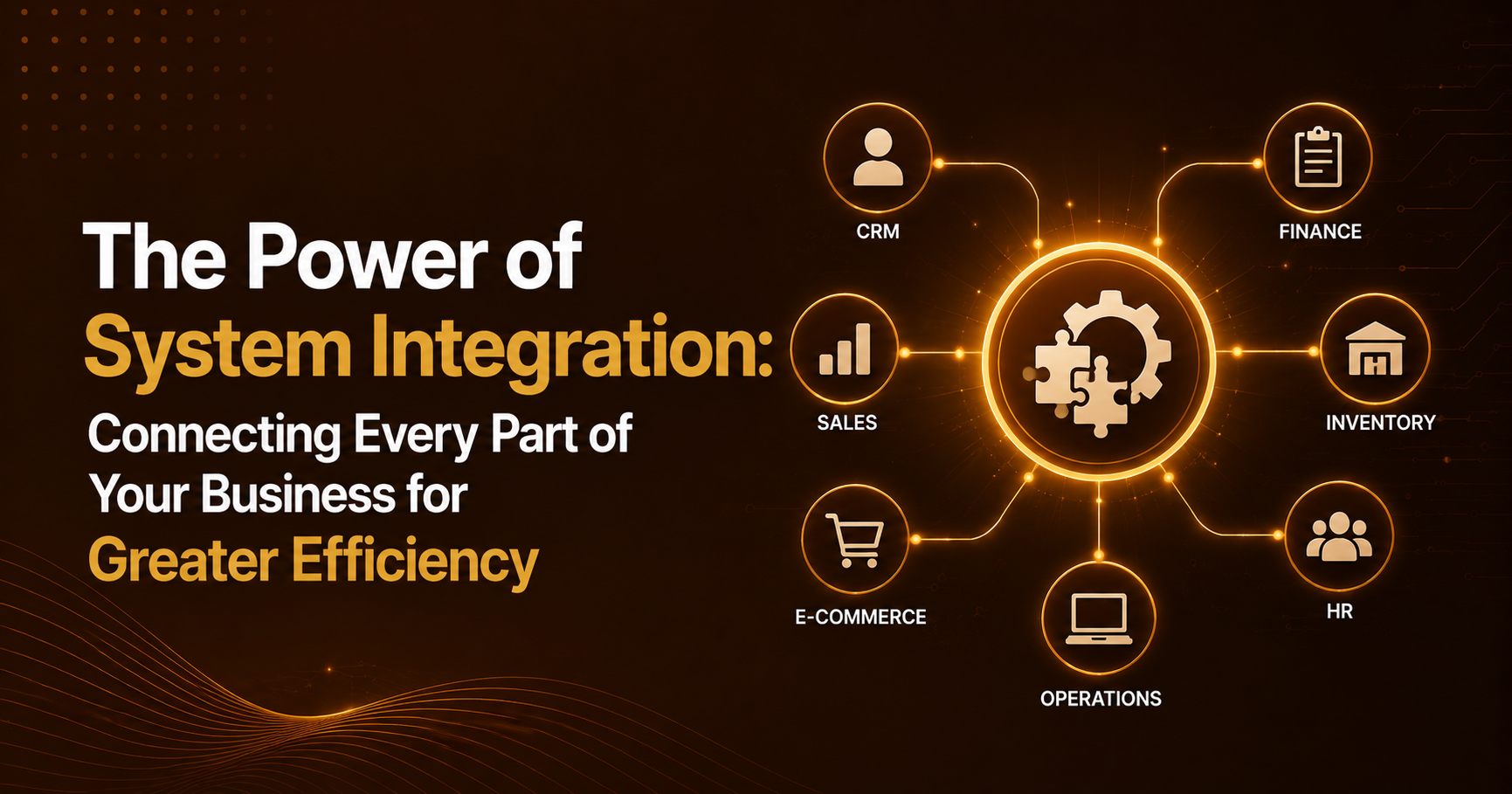

The Power of System Integration: Connecting Every Part of Your Business for Greater Efficiency
In today’s fast-paced digital landscape, businesses rely on a wide range of software solutions to manage their operations. Customer Relationship Management (CRM), Enterprise Resource Planning (ERP), accounting software, HR platforms, inventory management systems, marketing automation tools, and customer support applications each play a critical role in driving business success.
However, when these systems operate independently, organizations often face duplicated efforts, fragmented data, delayed decision-making, and reduced operational efficiency.
This is where System Integration becomes a strategic business enabler.
System integration connects multiple applications, databases, and business platforms into a unified digital ecosystem where information flows seamlessly across departments. Instead of working with disconnected systems, organizations gain synchronized data, automated workflows, and real-time visibility into business operations.
At BAIRACORP Private Limited, we help organizations design and implement intelligent system integration solutions that streamline operations, enhance collaboration, and support long-term digital transformation.
What Is System Integration?
System integration is the process of connecting different business applications so they can securely exchange information and operate as a single, cohesive system.
An integrated ecosystem may include:
- Customer Relationship Management (CRM)
- Enterprise Resource Planning (ERP)
- Accounting & Finance Systems
- Human Resource Management (HRM)
- Inventory & Warehouse Management
- Payment Gateways
- Customer Support Platforms
- Business Intelligence & Analytics Tools
- Cloud Applications
- Third-Party APIs
Instead of manually transferring information between systems, data is automatically synchronized across every connected platform.
The result is a faster, more efficient, and highly collaborative business environment.
Why System Integration Matters
As organizations grow, they naturally adopt specialized software to support different departments. While these tools improve individual business functions, disconnected applications often create operational inefficiencies that impact overall productivity.
Common challenges include:
Duplicate Data Entry
Employees spend valuable time entering the same information into multiple systems, increasing workload and reducing efficiency.
Data Inconsistency
When information is updated in one application but not another, departments often work with outdated or conflicting data.
Delayed Business Processes
Manual approvals, report generation, and information sharing slow down operations and affect customer responsiveness.
Limited Operational Visibility
Without connected systems, leadership lacks a comprehensive, real-time view of business performance, making strategic decision-making more difficult.
System integration eliminates these barriers by creating a centralized, connected technology ecosystem where every department works with accurate, real-time information.
Key Benefits of System Integration
Organizations that invest in system integration gain significant operational and strategic advantages.
Improved Productivity
Automation minimizes repetitive administrative work, allowing employees to focus on high-value initiatives that contribute to business growth.
Enhanced Data Accuracy
Automatic synchronization significantly reduces manual errors while maintaining consistency across all business applications.
Faster Decision-Making
Real-time access to reliable business data enables leaders to make informed decisions quickly and confidently.
Superior Customer Experience
Integrated customer information allows businesses to respond faster, personalize interactions, and deliver more consistent service.
Reduced Operational Costs
Automation lowers administrative overhead, reduces duplicate work, and optimizes resource utilization.
Greater Business Agility
Connected systems enable organizations to respond rapidly to changing customer expectations, market conditions, and business opportunities.
Breaking Down Data Silos
One of the most common obstacles to organizational efficiency is the existence of data silos.
When departments maintain isolated information, collaboration becomes difficult and decision-making suffers.
For example:
- Sales teams may not have real-time inventory visibility.
- Finance teams often depend on manually prepared reports.
- Customer support representatives may lack access to complete order histories.
- Management may struggle to obtain accurate performance insights across departments.
System integration removes these silos by ensuring that every department accesses consistent, centralized, and up-to-date information.
The result is stronger collaboration, improved transparency, and more efficient business operations.
Automating Business Processes Through Integration
One of the most powerful advantages of system integration is business process automation.
By connecting applications, organizations can automate repetitive workflows such as:
- Customer onboarding
- Lead management
- Invoice generation
- Purchase approvals
- Inventory synchronization
- Order processing
- Payment confirmations
- Status notifications
- Employee onboarding
- Business performance reporting
Automation reduces manual intervention, improves consistency, minimizes errors, and accelerates operational efficiency.
Employees spend less time on routine administrative tasks and more time delivering strategic value.
Supporting Scalable Business Growth
Business expansion introduces greater operational complexity.
Without integrated systems, managing increasing volumes of customers, transactions, and data becomes significantly more challenging.
A scalable integration strategy enables businesses to:
- Add new software applications seamlessly
- Expand into new markets
- Support growing customer demands
- Improve operational governance
- Standardize business processes
- Maintain consistent service quality
Rather than creating additional complexity, system integration ensures that technology scales alongside business growth.
Security and Compliance
Successful system integration goes beyond connectivity it also requires robust security.
Modern integration solutions incorporate industry-standard security measures, including:
- Secure authentication and authorization
- Encrypted data transmission
- Role-based access control
- Continuous monitoring and auditing
- Automated backup and disaster recovery
- Compliance with industry regulations
These safeguards ensure that organizations can share information securely while protecting sensitive business data and maintaining regulatory compliance.
How BAIRACORP Builds Connected Digital Ecosystems
At BAIRACORP Private Limited, we believe technology should simplify business not complicate it.
Our experts work closely with organizations to design customized system integration strategies that align with their operational goals and future growth plans.
Our capabilities include:
- Custom Software Development
- Enterprise Application Integration
- Business Process Automation
- Cloud Integration
- Digital Transformation Consulting
- Business Intelligence & Data Analytics
- IT Infrastructure Solutions
- API Development & Integration
Our proven methodology includes:
Discovery → Strategy → Solution Design → Implementation → Testing → Optimization → Continuous Support
This structured approach ensures every integration project delivers measurable improvements in productivity, collaboration, operational efficiency, and business performance.
The Future of System Integration
As businesses continue adopting AI, cloud computing, IoT, and data-driven technologies, system integration will become even more critical.
Organizations that successfully connect their digital platforms will benefit from:
- Intelligent automation
- Real-time operational visibility
- Faster innovation
- Better customer experiences
- Data-driven decision-making
- Sustainable long-term growth
A connected business is not only more efficient it is also more resilient, competitive, and prepared for the future.
Conclusion
Technology investments deliver maximum value when every system works together seamlessly.
System integration transforms disconnected applications into a unified digital ecosystem, enabling organizations to improve productivity, eliminate inefficiencies, strengthen collaboration, and accelerate business growth.
Whether your organization is modernizing legacy systems, integrating cloud applications, or automating complex business processes, the right integration strategy creates the foundation for long-term success.
At BAIRACORP Private Limited, we combine expertise in software engineering, digital transformation, business consulting, cloud technologies, and IT infrastructure to build secure, scalable, and future-ready integration solutions that empower businesses to thrive in a rapidly evolving digital world.
Ready to Transform Your Business with System Integration?
Discover how BAIRACORP Private Limited can help you connect your business systems, automate workflows, and build a smarter, more efficient digital ecosystem.
Visit: https://bairacorp.in
Empowering Businesses Through Intelligent Technology.

