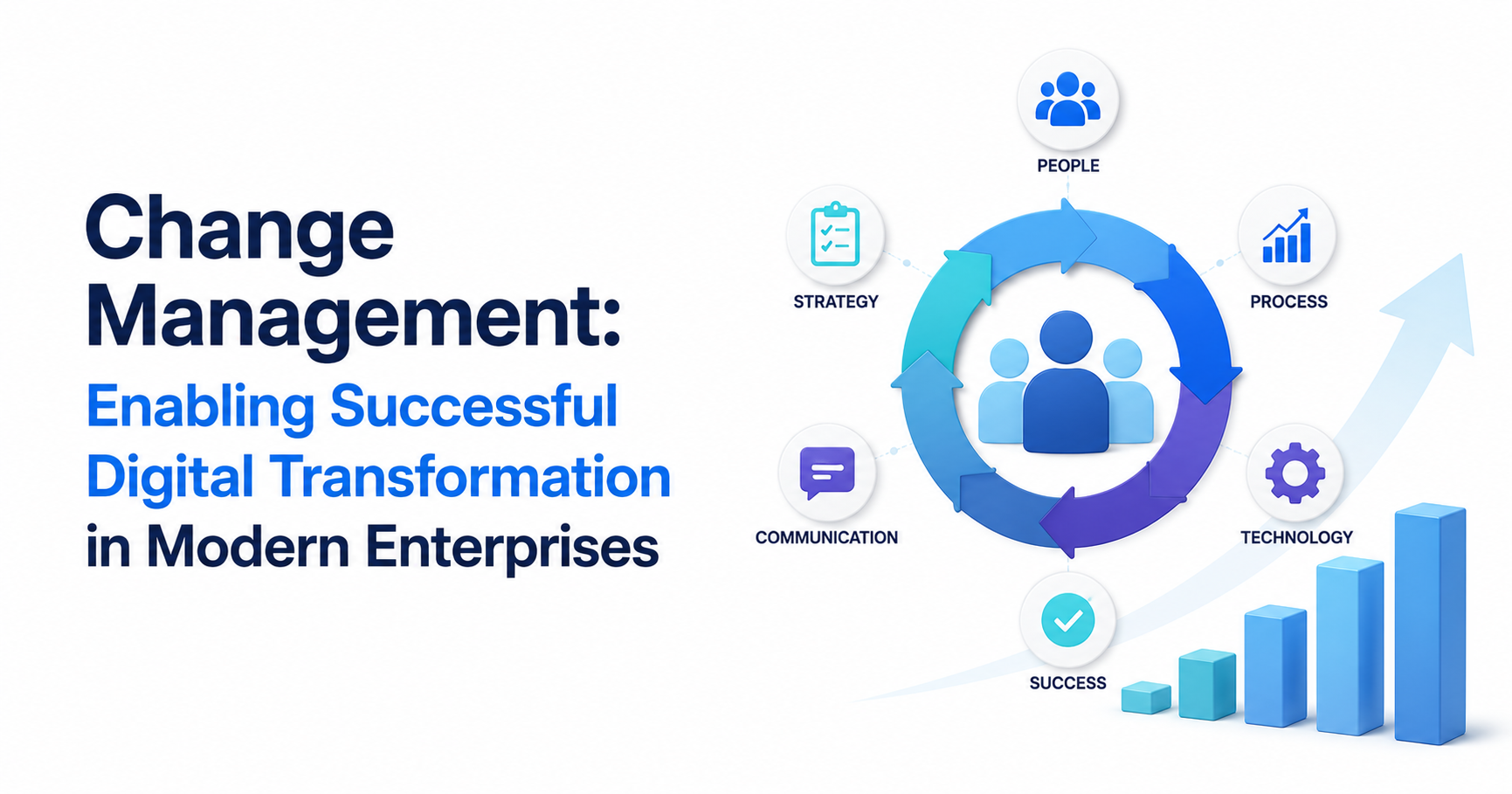

Change Management: Enabling Successful Digital Transformation in Modern Enterprises
In today’s dynamic business environment, organizations are rapidly adopting emerging technologies to remain competitive, improve operational efficiency, and deliver superior customer experiences. From cloud platforms and automation solutions to advanced analytics and AI-driven systems, digital transformation initiatives are becoming central to long-term business strategy.
However, technology implementation alone does not guarantee success.
The true challenge lies in ensuring that people, processes, and organizational culture evolve alongside technological advancements. Without proper alignment, even the most sophisticated digital initiatives can face resistance, low adoption rates, and limited business impact.
This is where Change Management becomes a critical success factor.
At its core, change management provides a structured framework for preparing organizations, engaging stakeholders, and guiding teams through transformation initiatives to ensure sustainable business outcomes.
Understanding Change Management
Change management is the systematic approach of managing organizational transitions from a current state to a desired future state. It focuses on ensuring that employees, leadership teams, business processes, and technologies work together effectively during periods of transformation.
Key components of change management include:
- Organizational readiness assessment
- Stakeholder engagement
- Communication strategies
- Training and capability development
- Process alignment
- Adoption monitoring and continuous improvement
The objective is not merely implementing change, but ensuring that the change is fully adopted, embraced, and capable of delivering measurable value.
Why Change Management Matters
Research consistently shows that a significant percentage of digital transformation initiatives fail to achieve their intended objectives due to organizational and human factors rather than technological limitations.
Common challenges include:
Resistance to Change
Employees may feel uncertain about new systems, changing responsibilities, or evolving workflows.
Communication Gaps
Insufficient communication often creates confusion, misinformation, and reduced engagement.
Low Technology Adoption
Organizations frequently invest heavily in technology platforms that remain underutilized because users are not adequately prepared.
Operational Disruptions
Poorly managed transitions can temporarily reduce productivity and impact service delivery.
Reduced Return on Investment
Without effective adoption, technology investments may fail to generate expected business outcomes.
A structured change management approach significantly reduces these risks and increases the likelihood of transformation success.
The Human Dimension of Digital Transformation
Every transformation initiative ultimately impacts people.
Employees naturally seek answers to questions such as:
- Why is this change necessary?
- How will it affect my role?
- What new skills will be required?
- What benefits will this create for the organization and for me?
Addressing these concerns proactively helps build trust, improve engagement, and foster a positive transformation experience.
Organizations that prioritize employee involvement and transparency consistently achieve higher adoption rates and better business outcomes.
Building Organizational Readiness
Successful transformation begins with preparation.
Before implementing new technologies or processes, organizations should evaluate:
- Existing operational processes
- Organizational capabilities
- Technology maturity levels
- Skill gaps and training requirements
- Leadership alignment and sponsorship
Readiness assessments help identify potential challenges early, enabling organizations to develop mitigation strategies and execute transformation initiatives more effectively.
A proactive approach significantly reduces implementation risks and accelerates value realization.
Communication: The Foundation of Successful Change
Clear, consistent, and transparent communication is one of the most critical elements of effective change management.
Employees should have a clear understanding of:
- The purpose of the transformation initiative
- Expected business outcomes
- Implementation timelines
- Individual roles and responsibilities
- Available support mechanisms
Continuous communication reduces uncertainty, encourages collaboration, and helps maintain momentum throughout the transformation journey.
Organizations that communicate effectively are better positioned to achieve sustainable adoption and long-term success.
Training and Capability Development
Digital transformation often requires employees to develop new competencies and adapt to evolving ways of working.
Organizations should invest in:
- Structured training programs
- Workshops and knowledge-sharing sessions
- Comprehensive documentation
- User support initiatives
- Continuous learning and development programs
Empowering employees with the necessary knowledge and skills increases confidence, improves productivity, and significantly enhances technology adoption.
Continuous capability development is essential for sustaining transformation success.
Leadership’s Role in Driving Change
Leadership commitment is a defining factor in successful transformation initiatives.
Effective leaders:
- Establish and communicate a clear vision
- Promote collaboration and engagement
- Address concerns proactively
- Support teams throughout the transition
- Reinforce the strategic importance of change
Visible leadership involvement builds organizational confidence and creates a culture that embraces innovation and continuous improvement.
Transformation initiatives are considerably more successful when leadership actively champions the change.
Measuring Transformation Success
Digital transformation should be continuously evaluated through measurable business indicators such as:
- Employee adoption and engagement levels
- Operational efficiency improvements
- Customer satisfaction metrics
- Technology utilization rates
- Productivity gains
- Business performance outcomes
Ongoing measurement enables organizations to refine strategies, address emerging challenges, and maximize return on investment.
Change management should therefore be viewed as a continuous capability rather than a one-time implementation activity.
How BAIRACORP Supports Organizational Transformation
BAIRACORP Private Limited supports organizations in navigating complex transformation initiatives through strategic consulting and technology-driven solutions.
Its expertise includes:
- Business Consulting
- Digital Transformation Strategy
- Software Engineering Solutions
- Data Analytics and Business Intelligence
- Process Optimization
- Strategic Planning
- Technology Adoption and Enablement
BAIRACORP follows a structured methodology that begins with understanding business challenges, designing practical and scalable solutions, implementing technology effectively, and supporting continuous optimization.
This approach enables organizations to realize sustainable business value while enhancing operational excellence and long-term competitiveness.
Looking Ahead
As technology continues to evolve, organizational adaptability will become one of the most important drivers of competitive advantage.
Future-ready organizations are those that can:
- Respond quickly to market changes
- Adopt emerging technologies effectively
- Deliver enhanced customer experiences
- Improve operational agility
- Foster a culture of continuous innovation
Digital transformation is no longer solely about implementing advanced technologies it is about building organizations that can successfully adapt to continuous change.
Conclusion
Successful transformation extends beyond technology implementation. It requires aligning people, processes, and organizational objectives to create lasting business impact.
Change management provides the framework necessary to minimize disruption, improve adoption, and ensure that transformation investments generate measurable value.
Organizations that invest in structured change management strengthen resilience, accelerate innovation, and build a culture capable of thriving in an increasingly digital and connected world.
With its expertise in consulting, software engineering, and digital strategy, BAIRACORP continues to help organizations navigate transformation journeys and build future-ready enterprises prepared for long-term success.

