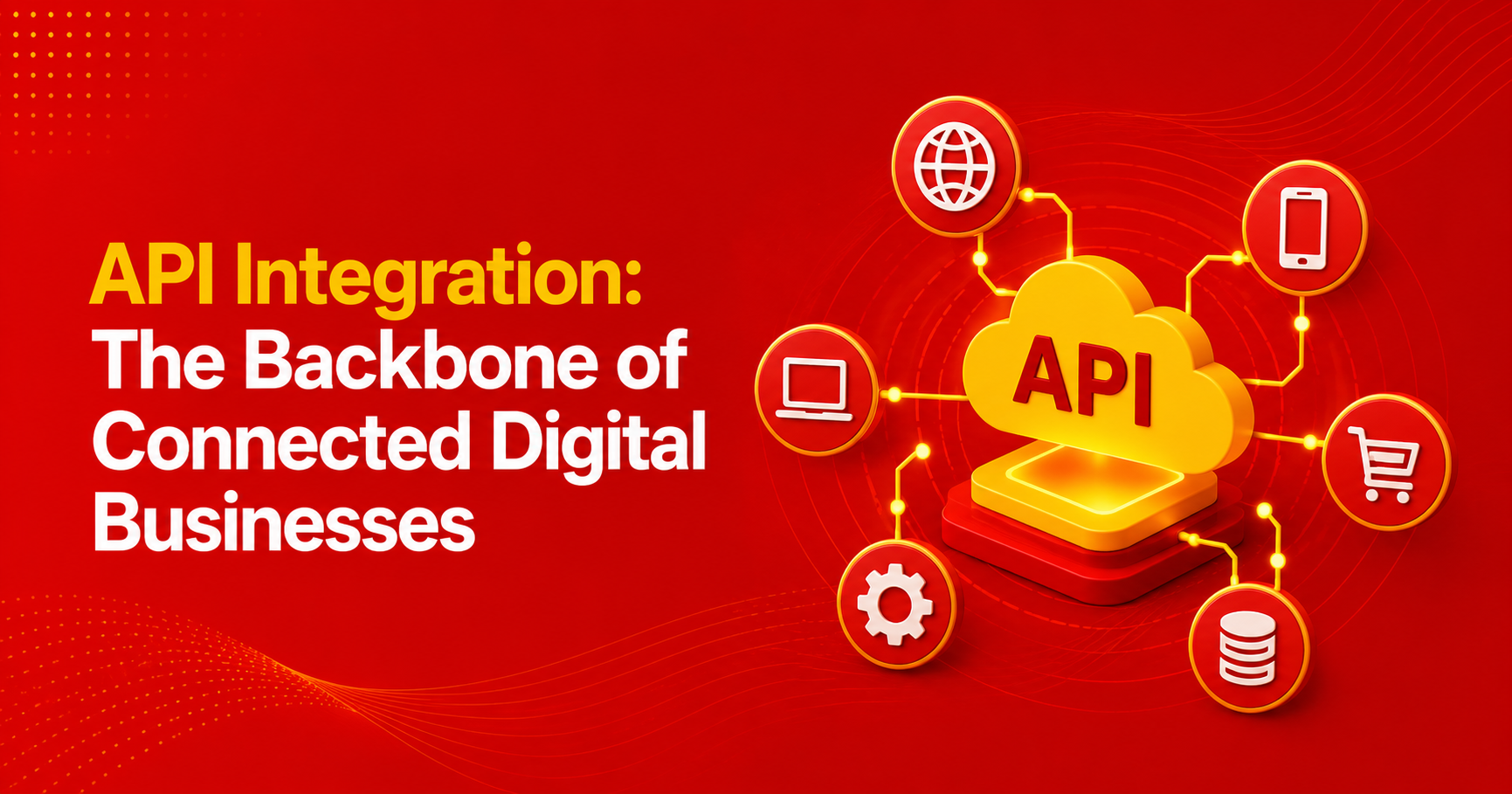

API Integration: The Backbone of Connected Digital Businesses
In today’s rapidly evolving digital landscape, businesses depend on multiple software platforms to manage operations, customer relationships, analytics, payments, communication, and workflows. However, when these systems function in isolation, they often create inefficiencies, data silos, and unnecessary manual effort.
This is where API Integration becomes essential.
API (Application Programming Interface) integration enables different software systems to communicate and exchange data seamlessly. It acts as the digital bridge connecting applications, allowing businesses to automate workflows, improve efficiency, and build unified ecosystems.
As organizations increasingly adopt specialized tools and cloud-based platforms, API integration has become a critical driver of scalability, operational excellence, and digital innovation.
What Is API Integration?
An API allows one application to securely communicate with another using structured data exchange.
For example, when a customer completes an online purchase, several systems may interact simultaneously:
- Website Frontend
- Payment Gateway
- Banking System
- CRM Platform
- Order Management System
- Notification Services
APIs ensure smooth communication between these systems without manual intervention.
This creates a seamless and efficient experience for both businesses and customers.
Simply put, APIs help software systems “talk” to each other.
Why Modern Businesses Need API Integration
Most businesses today rely on multiple digital tools to manage daily operations, including:
- CRM Platforms
- ERP Systems
- Accounting Software
- Analytics Dashboards
- Customer Support Tools
- Marketing Automation Platforms
- Cloud Infrastructure
Without integration, teams often transfer data manually between systems, leading to several operational challenges.
Data Duplication
The same information gets entered repeatedly across platforms.
Manual Errors
Human errors increase during repetitive data handling.
Delayed Operations
Processes become slower and less efficient.
Limited Visibility
Critical business information remains fragmented across systems.
API integration eliminates these challenges by creating a connected and intelligent operational environment.
Key Benefits of API Integration
Organizations that implement API-driven architectures gain significant business advantages.
Improved Efficiency
Automation reduces repetitive manual tasks and saves time.
Real-Time Data Synchronization
All systems stay updated instantly with accurate information.
Better Decision-Making
Unified data improves visibility, reporting, and analytics.
Enhanced Customer Experience
Faster workflows create smoother and more reliable customer journeys.
Greater Scalability
Businesses can integrate new tools and technologies with minimal disruption.
Connected systems help organizations operate faster, smarter, and more consistently.
API Integration and Workflow Automation
One of the most powerful advantages of API integration is workflow automation.
Many repetitive business operations can be automated through connected systems.
Examples include:
- Capturing leads from websites directly into CRM
- Generating invoices after purchases
- Sending automated email notifications
- Updating order status in real time
- Streamlining customer onboarding workflows
- Synchronizing business reports across platforms
Automation reduces operational overhead and allows teams to focus on strategic, high-value work.
This significantly improves productivity across departments.
APIs Power Modern Digital Products
Today’s digital products heavily rely on APIs for core functionality.
Examples include:
Payment APIs
Enable secure and seamless online transactions.
Messaging APIs
Power SMS, email, and push notifications.
Authentication APIs
Provide secure login and access management.
Analytics APIs
Deliver real-time insights and reporting.
Cloud APIs
Enable efficient infrastructure and service connectivity.
Without APIs, building scalable modern digital products would be far more complex.
APIs have become the foundation of software innovation.
Security in API Integration
Since APIs exchange critical business data, security is a top priority.
Secure API development requires:
- Strong Authentication Mechanisms
- Role-Based Authorization Controls
- End-to-End Data Encryption
- Rate Limiting
- Access Monitoring
- Threat Detection
Poorly secured APIs can expose sensitive business information and create major vulnerabilities.
Organizations must adopt modern security practices to ensure safe and reliable integrations.
Security and performance must always go hand in hand.
Scalability Through API-First Architecture
Modern software architecture increasingly follows an API-first approach.
This means systems are designed with integration capabilities from the beginning.
Key benefits include:
- Faster Product Development
- Easier Third-Party Integrations
- Modular System Architecture
- Improved Maintainability
- Stronger Scalability
API-first systems enable businesses to adapt quickly to changing technologies and market demands.
This creates long-term flexibility and resilience.
API Integration in Digital Transformation
Digital transformation often involves adopting multiple platforms, services, and cloud solutions.
API integration ensures these technologies function together as a unified ecosystem.
This enables:
- Operational Efficiency
- Process Automation
- Cross-Platform Communication
- Unified Analytics
- Faster Innovation
Without strong integration, digital transformation initiatives often remain incomplete.
Connected systems unlock the true value of technology investments.
How BAIRACORP Helps Businesses Build Connected Systems
BAIRACORP Private Limited helps businesses build scalable digital ecosystems through modern software engineering and intelligent integration solutions.
Core expertise includes:
- API Integration
- Custom Software Development
- Cloud Infrastructure
- Digital Transformation
- IT Architecture
- Workflow Automation
- Business Consulting
BAIRACORP develops secure, scalable, and high-performance integration solutions that connect business systems efficiently.
Its engineering approach emphasizes:
- Reliability
- Performance
- Security
- Long-Term Scalability
This ensures businesses remain future-ready in an increasingly connected world.
Looking Ahead
As businesses continue adopting cloud services, SaaS platforms, and automation technologies, API integration will become even more critical.
Future-ready organizations will increasingly depend on connected systems to improve:
- Agility
- Productivity
- Customer Experience
- Operational Intelligence
- Innovation Speed
The future belongs to businesses with seamless digital connectivity.
Conclusion
In the modern digital economy, disconnected systems create inefficiencies and slow business growth.
API integration solves this challenge by connecting applications, automating workflows, and enabling real-time data exchange.
Organizations that invest in strong integration architecture gain greater efficiency, scalability, and business agility.
With deep expertise in software engineering, architecture, and digital consulting, BAIRACORP continues to help businesses build connected, intelligent, and future-ready digital ecosystems.
Ready to Connect Your Business Systems?
Visit Bairacorp.in
Empowering Businesses Through Seamless Integration, Smart Automation, and Scalable Technology Solutions.

